How to Cascade Objectives to Build Alignment and Employee Engagement

When you're leading a team, you can often create alignment through direct conversations. You explain the priorities, help people understand what's expected, and stay close enough to the work to recognize when something isn't moving in the right direction.
But what happens when you're leading a function with hundreds of people, through managers who lead other managers?
You can't be in every meeting. You can't personally explain every decision. And you can't rely on everyone hearing your message in the same way.
Your leaders need to be able to create that alignment themselves.
One of the first things I'd do when stepping into a VP or senior executive role is establish a clear line between the company's objectives and the work people do every day. Not just so people know what they're working on, but so they understand why it matters, how their work contributes, and where they have the freedom to make decisions.
That requires more than communicating a set of goals. It requires a system.
Start with a clear line from strategy to execution
I learned the principles of cascading objectives early in my career at HP. I've adapted them many times since, across different companies, teams, and stages of growth.
The basic idea is straightforward: the work happening throughout your organization should connect to what the company is trying to accomplish. But that connection needs to be made explicit.
Company objectives: What is the business trying to accomplish?
Function objectives: What does our function need to contribute to those outcomes?
Strategies: How have we chosen to accomplish our objectives?
Business metrics: How will we know whether our strategies are working?
Operating processes: What needs to happen consistently to support execution?
Work and decisions: What are people actually doing, prioritizing, solving, and deciding?
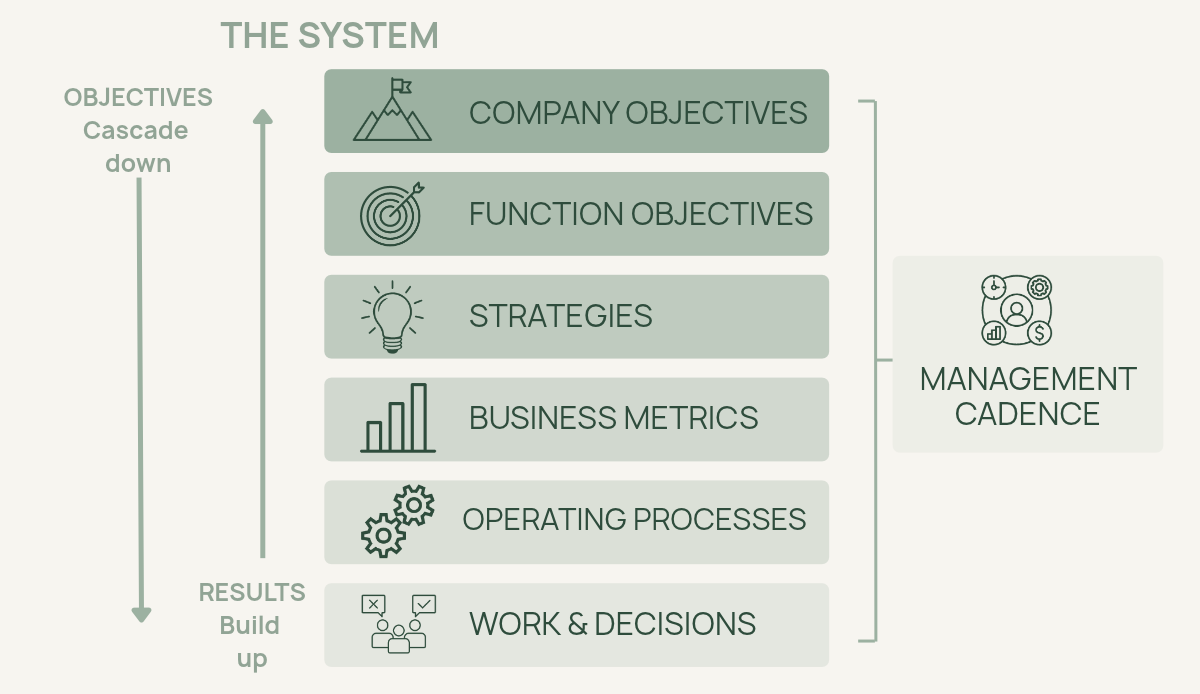
A management cadence connects these elements through regular reviews of progress, results, decisions, and necessary adjustments.
Objectives cascade down through the organization. Results build up from the work.
The connection should be visible in both directions.
If you start with a company objective, you should be able to trace how your function contributes, which strategies support that contribution, what you're measuring, and what teams are doing to produce the results.
And if you start with someone's day-to-day work, you should be able to trace how it contributes to an objective.
When you can't make those connections, that's worth exploring.
It might mean the strategy isn't clear, the measures aren't telling you what you need to know, or the work has evolved without anyone revisiting whether it's still the right work.
Try this: Bring your leadership team together and map what exists today. Don't start by creating a new framework. Start by understanding the connections you already have and where they're missing.
What cascading objectives looks like in practice
Here's a simplified example from my time leading North America Professional Services at Snowflake.
When I joined in 2019, one of the company's objectives was to grow revenue. For Professional Services, an important part of supporting that objective was helping new customers reach meaningful consumption of Snowflake faster.
That became a functional objective: reduce the time it took new customers to reach meaningful consumption.
Our strategy was to create, sell, and deliver services designed to accelerate time to customer value and meaningful consumption.
We needed measures that would help us understand whether the strategy was working, including:
The rate at which services were attached to new sales
Time to start services and begin consumption
Time to meaningful consumption
Utilization
But those measures didn't translate into identical work for every team.
Services Sales needed to attach the right services to new customer engagements.
Operations needed to ensure we could staff and start engagements quickly.
Delivery needed to help customers become self-sufficient and successful.
Managers needed to oversee capacity, projects, and customer progress.
Same objective. Different teams. Different work.
That's what cascading objectives should accomplish.
The point isn't to give everyone the same goal or ask them to repeat the company's priorities.
It's to help each team understand the contribution it needs to make, how that contribution will be measured, and what work will move the results.

It also gives leaders a way to work together. If services are selling well but engagements aren't starting quickly, that's a different problem from engagements starting on time but customers struggling to reach value.
The measures help us see where to look. The management cadence gives us a way to discuss what we're learning and decide what needs to change.
Be concrete about objectives and strategy. Allow flexibility in execution.
This is one of the distinctions I think matters most.
As you move down through the framework, the amount of flexibility should change. At the top, company and functional objectives need to be clear and consistent. Strategies need enough definition to keep people moving in the same direction.
This is where new ideas can sometimes become a distraction.
A new idea might be interesting. It might even be a good idea. But that doesn't mean it supports what the organization has committed to accomplish.
Closer to the work, however, people need more flexibility.
Once the objectives, strategies, and measures are clear, teams should have room to determine how to get the work done.
The people closest to the work often understand the problems, constraints, and opportunities better than anyone else. They may have ideas that a senior leadership team would never have considered.
You want that thinking.
Clear direction shouldn't eliminate creativity. It should help people apply their creativity to the work that matters.
For a senior leader, that means being intentional about what is fixed and what isn't.
Where do you need consistency across the organization? Where do you want people to experiment? Which decisions should teams make independently, and which require broader alignment?
If those boundaries aren't clear, people can end up in one of two places: waiting for direction on decisions they should be empowered to make, or moving quickly on work that isn't aligned with the strategy.
Neither is particularly effective.
One question I'd want everyone in the organization to be able to answer is:
*Do I know what's expected of me at work? Not just what tasks they're responsible for, but what outcomes matter and where they have room to decide how to achieve them.
Alignment doesn't stop at the boundaries of your function
There's another dimension to alignment that can be easy to overlook.
You can have a function with clear objectives, strong execution, and excellent performance against its own measures—and still create problems for the rest of the business.
That's because functions don't operate independently.
Your team's success may depend on another function's capacity, priorities, or decisions. And the way your team pursues its objectives may create challenges for someone else.
For example, one team might optimize for speed while another is accountable for quality or capacity. Both could be doing exactly what their measures encourage them to do, while the overall customer experience suffers.
That's why alignment needs to work across the organization, not just down through it.
When developing functional objectives and strategies, I'd encourage leaders to sit down with the peers they depend on most.
Ask each other:
Where do our priorities reinforce each other?
Where could our objectives or measures compete?
Who depends on us, and who do we depend on?
What decisions or problems need to be solved together?
These conversations can reveal conflicts that aren't visible when each function develops its plans independently.
And they're part of the transition into more senior leadership.
You're no longer accountable only for how well your function performs. You need to understand how your function contributes to the success of the business as a whole.
How do you know whether your organization is aligned?
Having a framework doesn't necessarily mean people understand it.
You can build a beautiful strategy presentation, review it with your leadership team, and communicate it across the organization.
But can the people doing the work explain how their contribution connects to the objectives?
Here are ten questions I'd use to assess alignment:
What is the company trying to accomplish?
What does our function need to contribute or deliver?
What strategies have we chosen, and why?
How will we know whether they're working?
How do we share progress across the team?
What operating processes support the work?
What decisions and work do our teams own, and where do they have flexibility?
Who do we depend on, and who depends on us?
How does our work drive business results?
What work are we doing today that no longer supports our objectives?
You don't need to turn this into a formal assessment. Start with a conversation.
In your next skip-level meeting, ask someone what the organization is trying to accomplish, why it matters, and how their team's work contributes.
Listen to how they explain it.
If they can't make the connection, I'd be curious about where it was lost.
Was the objective unclear? Did their manager have enough context to translate it? Have priorities changed without the communication catching up? Are the measures encouraging something different from what leadership intended?
Those answers can tell you a lot about where your leadership system needs attention.
Building alignment requires a shift in how you lead
When you move into a senior leadership role, your ability to create results increasingly depends on what other leaders are able to accomplish.
You need them to understand the direction, make decisions, solve problems, develop their teams, and recognize when something isn't working.
You can't do that for everyone.
But you can create the conditions that make it possible.
For me, cascading objectives is one of the ways to do that. It connects strategy to execution, gives leaders a shared understanding of what matters, and helps teams make better decisions without waiting for direction on everything.
And it gives you a way to step back from the daily work and ask a bigger question:
Can the leaders throughout your organization explain where you're going, why it matters, and how their teams will help get you there?
That's a question worth making time for.
At Cambium, I work with rising and senior technology leaders who are navigating the transition from leading teams to leading through leaders. If you're working through what needs to change as your scope grows, I'd welcome a conversation about how executive coaching could support you.


